

Recent Acquisitions
On this page you'll find my latest acquisitions.
This way you can quickly browse through my recently acquired objects without having to browse through all the various categories.
After some time, each object in 'Recent Acquisitions' will be moved to their specific category.
Latest update: Recent Acquisitions; June 17, 2026.
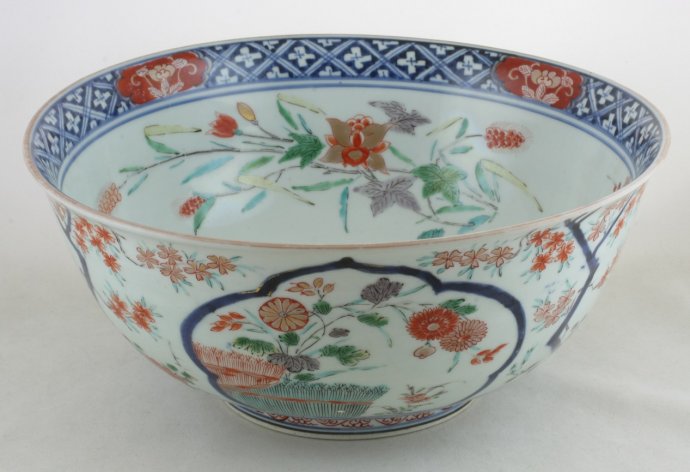
Japanese Imari 1690-1800
Object 2012731
Bowl
Japan
c.1700
Height 117 mm (4.61 inch), diameter 265 mm (10.43 inch), diameter of footring 107 mm (4.21 inch), weight 1,157 grams (40.81 ounce (oz.))
Bowl on footring, straight sides with a slightly flaring rim and edge. A single spur-mark on the base. Imari, decorated in underglaze blue, iron red, green, turquoise, aubergine, black, yellow and gold. In the centre a flowering Camelia Japonica flower spray. On the sides two wide spread flower sprays. Round the rim a geometrical pattern border in underglaze blue with four reserves filled with a flower spray in reverse decoration on an iron-red ground. The outside with three outlined reserves filled with flowering chrysanthemum plants growing from behind bounded hedges. In between the panels flowering peony plants and wide spread flowering cherry trees. Round the foot a circular geometrical pattern border in underglaze blue and on the foot a continuous floral scroll in iron-red. On the base a large Artemisia leaf in underglaze blue outlined in gold.
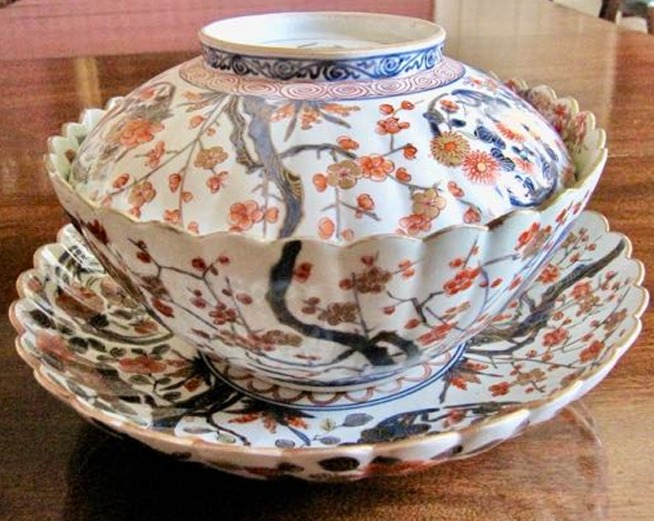
With sets of under dish, bowl and cover, the decoration of the trunks continue on the matching cover and under dish. These covers and under dishes are now mostly missing. It is rare to see complete sets. Here you can see an example of a complete set with matching decoration on the cover and under dish. This example was found in England and is in an English private collection.
Condition: A firing flaw to the inner wall and some loss of enamel.
Price: Sold.
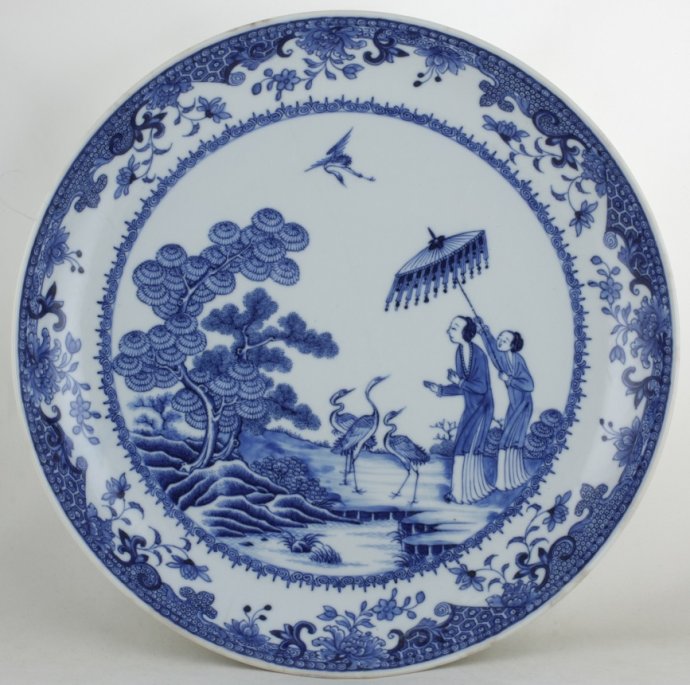
Chine de commande - Western Subjects 1680-1800 - Western Designers - Pronk, Cornelis (1691-1759)
Object 2012722
Dish
China
c.1750
Height 44 mm (1.73 inch), diameter of rim 279 mm (10.98 inch), diameter of footring 166 mm (6.54 inch), weight 672 grams (13.70 ounce (oz.))
Dish on footring, straight rim. Decorated in underglaze blue with a scene reminiscent of Pronk's 'Parasol Lady' design, with a lady standing in a garden near a waterfront gesturing at three cranes in front of her and one in flight while her attendant is holding a tasselled parasol. Various plants and trees are growing near the waterfront. the central scene is outlined by a spiralling border. On the sides flower sprays hanging down from a honeycomb diaper-pattern border. The reverse is undecorated.
Imitations of Pronk Porcelain
For the Dutch East India Company, (Vereenigde Oost-Indische Compagnie, VOC) porcelain made to order after the drawings by Cornelis Pronk proved not to be profitable enough. Private traders however, saw how well it sold, which prompted them to commission simplified versions. This was the beginning of the production of all sorts of blue and coloured versions of this ware, among others of tea ware and of plates. Quite extraordinary were the Japanese imitations of Pronk Porcelain, which featured Japanese geishas instead of the well-known Chinese parasol ladies. This variant was later in turn copied in China as well. After it arrived in the Netherlands, blue Chinese porcelain was occasionally over-decorated in enamel colours (Amsterdams Bont), whereby the Pronk motif was copied as well. English imitations were seen far into the 19th century, while this motif even appears to have still been applied on Maastricht ware of as late approximately 1900. (Source: Groninger Museum)
The design on this dish is an excellent example of an interpretation of Pronk's 'Parasol Lady' design by the Chinese porcelain painters themselves, maybe meant for the own domestic market as an exotic item, an 'Europeanerie'. In this case the waterbirds beside marsh grasses have been replaced by pheasants, while the insects on the reverse have been deleted. Furthermore, the design was also widely copied in Europe, for example by the Venetian Porcelain Factory Cozzi, the Dutch Ouder-Amstel Porcelain Factory and Delft factories. At Delft, there were plain white objects decorated with the Chinese version of the Parasol Ladies. Until the mid to late 19th century the pattern of the 'Parasol Lady' was still used on European porcelain, for example at the famous Herendt Factory in Hungary and at the Porcelain Factory of Maastricht, the Netherlands.
Condition: Restored.
Reference:
Price: Sold.
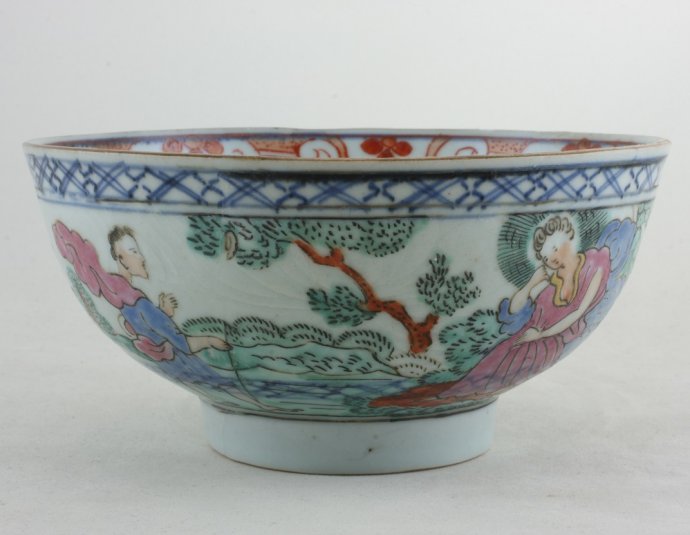
Chinese wares over-decorated in the West 1700-1800 - Dutch over-decorated Amsterdams Bont
Object 2012726
Bowl
China
1730-1750, over-decorated in the Netherlands, Amsterdams Bont, c.1730-1760
Height 73 mm (2.87 inch), diameter of rim 151 mm (5.94 inch), diameter of footring 64 mm (2.56 inch), weight 309 grams (10.90 ounce (oz.))
Bowl on footring with a straight underglaze brown-edged rim (jia mangkou). Carved anhua (secret) decoration of leafy branches. Decorated in underglaze blue with two diaper pattern borders one near the footring the other round the rim. On the bottom a flower head in a single concentric band. Over-decorated in iron-red, black, gold and other overglaze enamels, in the Netherlands, Amsterdams Bont, c.1730-1760 with two figures in a landscape with trees and bushes. One divine figure (the Virgin Mary) is sitting under a tree her elbow resting on his leg while her hand is supporting her head. The other figure (the Angel Gabriël) is approaching while holding a stick, his scarf is being blown up by the wind.
The over-decoration on this bowl represents "The Annunciation". The moment when the Angel Gabriël announced to the Virgin Mary that she would conceive and give birth to Jesus Christ. It is described in the Gospel of Luke (Luke 1:26-38). According to the Christian tradition: The Angel Gabriël was sent by God to Mary in Nazareth. Gabriël greeted her with the words: 'Hail, full of grace, the Lord is with thee'. He told her she would bear a son named Jesus, who would be called the Son of God. Mary asked how this could happen, since she was a virgin. Gabriël explained that the conception would occur through the Holy Spirit. Mary accepted with humility: 'Behold the handmaid of the Lord; be into me according to ty word'.
The Annunciation is one of the central moments in Christianity because it marks the beginning of the incarnation - God becoming human in Jesus Christ. It is traditionally celebrated on March 25, exactly nine months before Christmas.
For an identically decorated dish in the collection of Museum Boymans - van Beuningen, Rotterdam, please see:
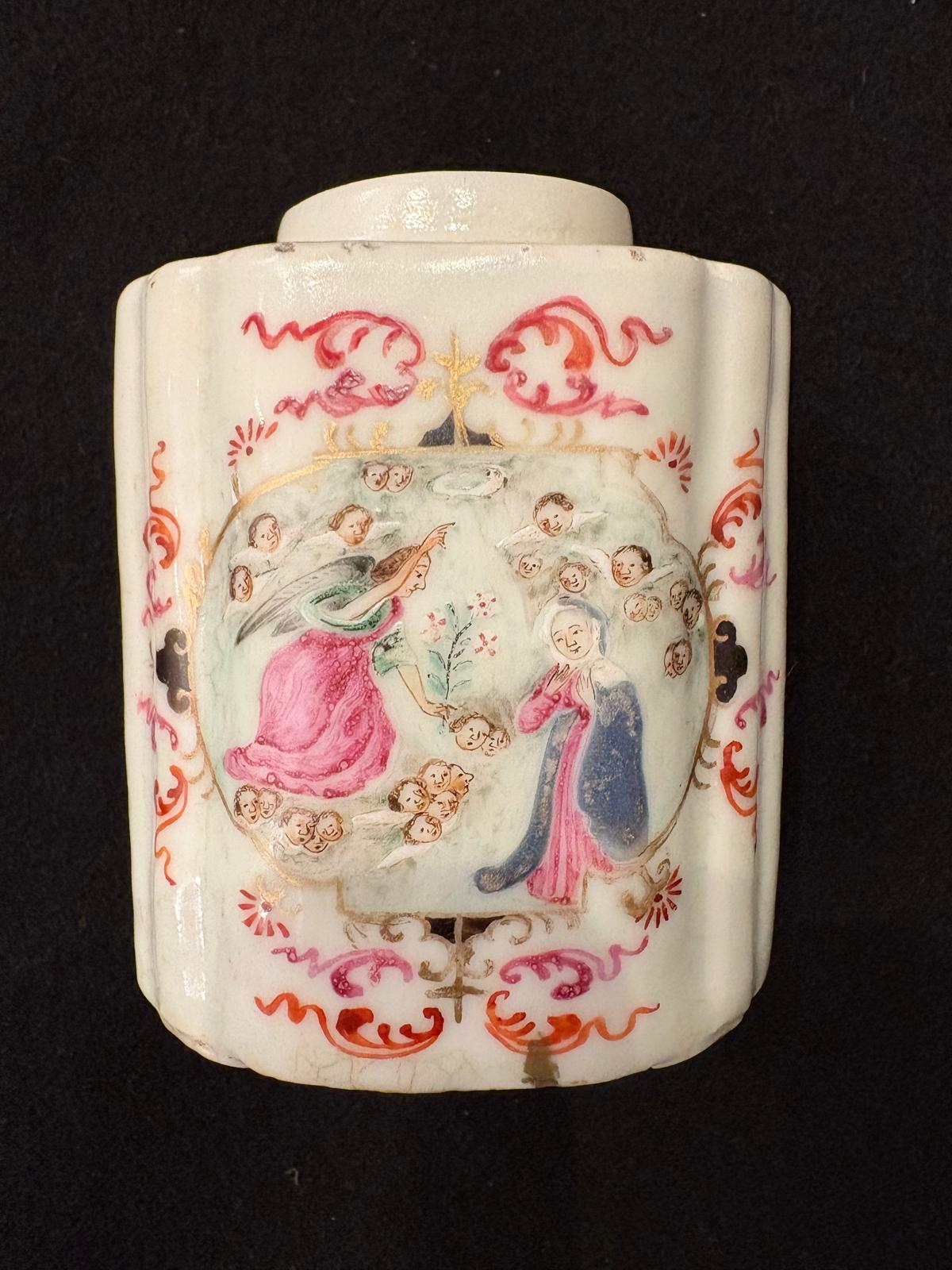 A A tea caddy with a similar 'The Annunciation' decoration. (Image courtesy: Paulo Cunha Alves Collection, Lisbon Portugal)
Anhua is a Chinese term meaning 'secret or hidden decoration', it is incised or carved into the body below the glaze. (Espir 2005, p.254)
Condition: Restored.
References:
Hervouët 1986, no. 13.1 & 13.2
Price: Sold.
Japanese Imari 1690-1800
Object 2012730
Dish
Japan
1700-1730
Height 45 mm (1.77 inch), diameter 265 mm (10.43 inch), diameter of footring 168 mm (6.61 inch), weight 882 grams (31.11 ounce (oz.))
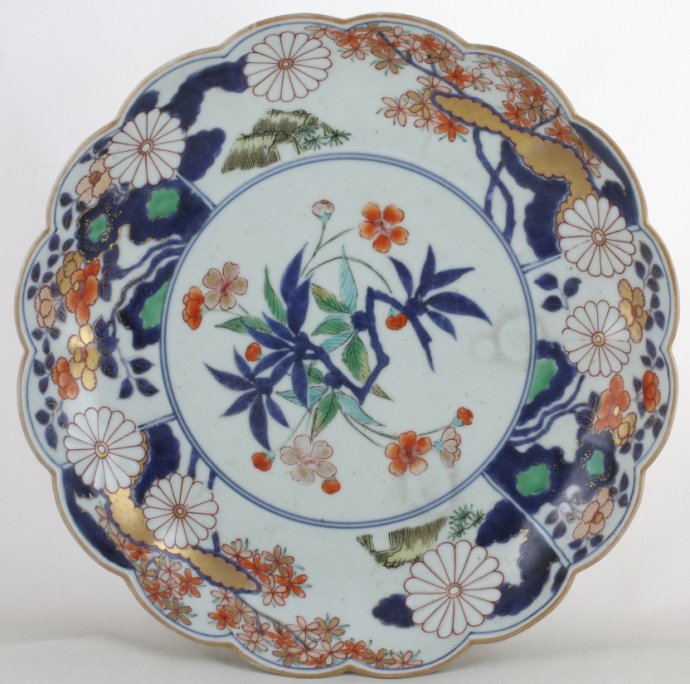
Dish on footring, spreading sides and a lobbed rim. On the base eight spur-marks. Imari, decorated in underglaze blue, iron-red, various overglaze enamels and gold with a flower spray in a central roundel. The sides and rim are divided into four panels. Two panels are filled with rockwork, flowering Camelia japonica plants and scattered kiku flowerheads in low relief. The other two panels ae filled with a house with grasses, clouds, flowering cherry plants and scattered kiku flowerheads in low relief. On the reverse a continuous leafy and flowering cherry scroll
This dish was most likely originally came with a matching covered bowl which is now lost.
Condition: Perfect.
Price: Sold.
Japanese wares with Western Shapes or Designs 1653-1800
Object 2012725
Sand brick
Japan
1680-1700
Height 65 mm (2.56 inch), dimensions 135 mm (5.32 inch) x 55 mm (2.17 inch), weight 424 grams (14.96 ounce (oz.))
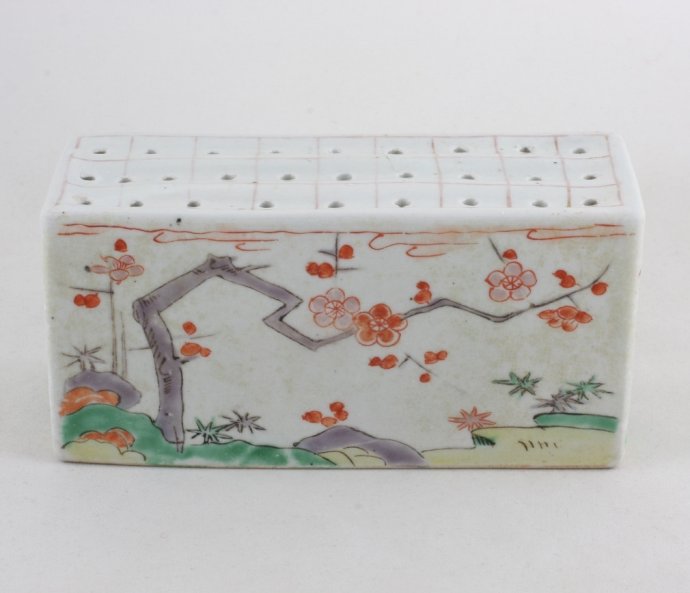
Sand brick of rectangular shape on a flat unglazed base. Hollow with three shallow domed top rows with small holes. Imari decorated, on the wide sides in, iron-red and yellow, aubergine, green, grey, black enamels and gold with a wide spread gnarled blossoming prunus growing from rockwork with small plants. On the smaller sides flowering bamboo plants growing from rockwork. Round the rim swirling clouds. The holes are square outlined in iron-red.
In the West, quill pens were used for writing and the ink was dried by dusting it with fine sand. A sander like this came with an matching inkstand. These type of writing sets will have been based on a European metal or earthenware model and must have been luxury items. The sand brick, which had to be filled from above, should not be confused with the later and much larger Chinese flower bricks. Apparently, such writing sets were only made in Arita and no Chinese examples are recorded. Curiously, the very few complete sets known have a particular kakiemon-style decoration. Sets must also have existed in underglaze blue and Imari, as is indicated by single examples of sand bricks and inkstands. (Jörg 2003/1, p.188)
For similarly shaped sand bricks, please see:
- Japanese Porcelain, (S. Jenyns, Faber & Faber, London / Boston, 1979), cat. 65Aii.
- Fine & Curious: Japanese Export Porcelain in Dutch Collections, (C.J.A. Jörg, Hotei Publishing, Amsterdam 2003), pp.188-189, cat. 234 & 235.
Another similarly shaped, sized and decorated sand brick is in an English private collection.
Condition: Overall fine crazing to the glaze, a chip to a corner and a fleabite to a hole.
References:
Price: Sold.
Japanese wares with Western Shapes or Designs 1653-1800
Object 2012658
Shaving bowl with matching ewer
Japan
1700-1720
Height shaving bowl 101 mm (3.97 inch), dimensions rim 345 mm (13.58 inch) x 280 mm (11.02 inch), dimensions footring 157 mm (6.18 inch) x 127 mm (5.00 inch), weight 1.754 grams (61.87 ounce (oz.))
Height ewer 183 mm (7.20 inch), diameter mouthrim 110 mm (4.33 inch), diameter footring 92 mm (3.62 inch), weight 933 grams (35.03 ounce (oz.))
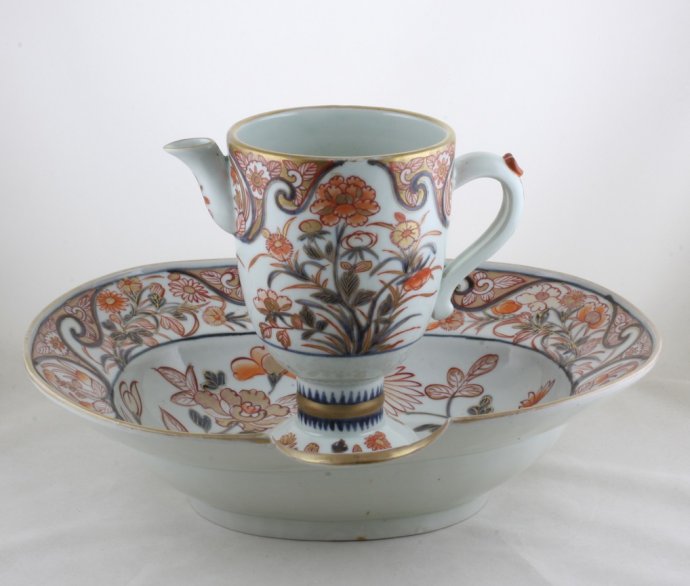
Oval shaving bowl, spreading flat rim with a semicircular section saved in the lower part In the basin. A ring in low relief to fit the matching ewer. Imari, decorated in underglaze blue, iron-red and gold with a flowering peony spray in the central ring in low relief flanked by wide spread flowering peony and chrysanthemum sprays tied with a ribbon with tassels. On the rim flowering peony and chrysanthemum sprays in wavy shaped panels and flowering plants in onion shaped panels flanked by flowerheads on a golden ground. The pitcher is decorated en suite.
Shaving bowls were used by barbers and were indispensable in the Dutch household too. They were made of earthenware, pewter, copper and even silver. They had an alternative use namely, to let blood from a vein in the arm during blood-letting, a medical procedure thought to drain bad blood from the system also performed by the barber/surgeon. In the seventeenth century, regulations were put in place in England to govern what barbers were permitted to do. Thus the became confined to bloodletting and treating external diseases. In Prussia the barbers' and the surgeons' guild joined in 1779, and it was said of great Prussian surgeons that they had risen "up from the barber's bowl'. Both purposes explain the semi-circular saving. The two holes are for a cord used to suspend it from the client's neck to catch lather and water during shaving, or to hang the bowl on the wall thus implying that owners also appreciated the bowl for its decorative value as well as its function. Chinese shaving bowls usually have the holes in the footring while Japanese examples have them in the rim. (Jörg 2003/1, p.184), (Sargent 2012, p.189)
These forms have also been called shaving basins as well as Mambrino's helmets, a name that comes from Cervante's novel The Life and Achievements of Don Quixote de la Mancha, in which the title character uses the bowl of the barber Mambrino as a helmet. (Sargent 2012, p.189)
The ewer is a close copy of similar European metal of faience ewers produced in the late 17th and early 18th centuries. (Jörg 2011/2, p.150)
Condition: A small chip to the underside of the edge of the semicircular section.
References:
Price: Sold.
Chinese Imari 1700-1800 - Tea, Coffe and Chocolate wares
Object 2012691
Saucer
China
1730-1750
Height 21 mm (0.83 inch), diameter of rim 113 mm (4.45 inch), diameter of footring 57 mm (2.24 inch), weight 69 grams (2.43 ounce (oz.))
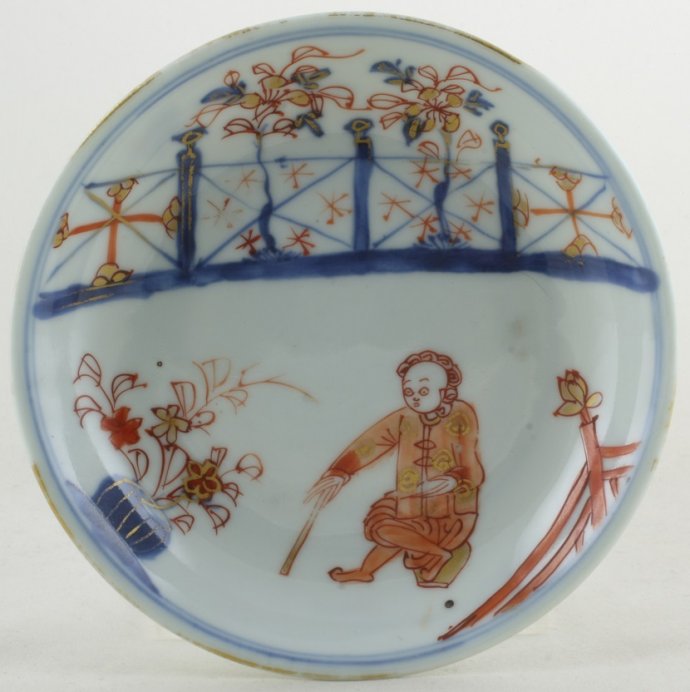
Saucer on footring, slightly everted rim. Chinese Imari, decorated in underglaze blue, overglaze iron-red and gold with a seated figure with a walking cane and a clearly European appearance, hair style and clothing, in the background a fence with flowering plants.
Sotheby's Ca Mau Shipwreck, circa 1725, auction sale catalogue shows an illustration intended to provide instructions for the Chinese porcelain painters on the ways and appearance of unfamiliar foreigners. The foreigner depicted on this saucer is clearly such an unfamiliar (European) foreigner. (Amsterdam 2007, pp.213-214)
Condition: Some glaze rough spots to the rim.
Reference:
Price: € 249 Currency Converter
Japanese Tea, Coffee and Chocolate wares 18th Century
Object 2011287
Tea bowl and saucer
Japan
1700-1730
Height of tea bowl 40 mm (1.57 inch), diameter of rim 62 mm (2.44 inch), diameter of footring 25 mm (0.98 inch), weight 40 grams (1.41 ounce (oz.))
Height of saucer 22 mm (0.87 inch), diameter of rim 113 mm (4.45 inch), diameter of footring 48 mm (1.89 inch), weight 83 grams (2.93 ounce (oz.))
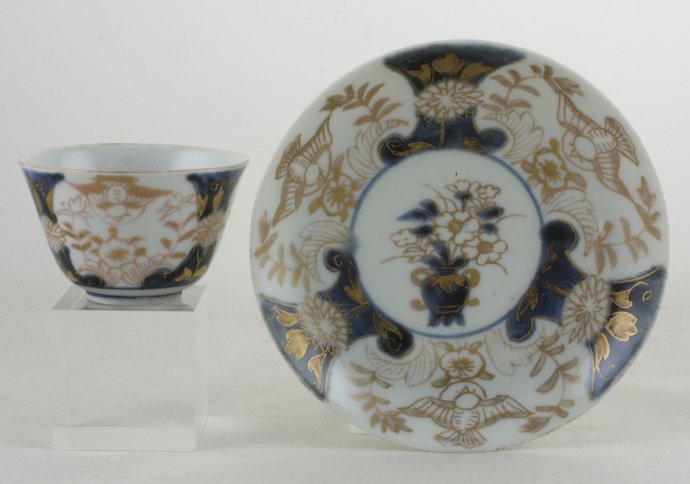
Tea bowl and saucer on footrings with spreading sides with slightly flaring rims. Imari decorated in underglaze blue and gold with a flowerpot filled with flowering cherry stems in a central roundel. On the sides three reserves filled with a bird in flight amongst flowering plants an leafy branches, alternating with a leafy flowering chrysanthemum stem in gold on an underglaze blue ground. The tea bowl is decorated en suite.
Condition: The footring of the tea bowl with glazed firing flaws.
Price: € 149 Currency Converter
 create websites